“We are so happy to have you here,” he says. “I hope you find it beautiful, and tell everyone where you are from how friendly we are.”
Then he stamps my documents and waves me in, beaming long after I pass through the airport doors.
Although it has something of an international reputation as “China lite,” Taiwan possesses a vibrant national identity and pride of its own. Despite (or perhaps because of) lingering Chinese, Japanese and Dutch colonial influences, the sweet-potato-shaped island has fought to express its cultural, economic and political independence, and a strong youth culture combined with the marks of more than a dozen aboriginal tribes lend it today a dynamic air of self-rediscovery.
My delight in exploring the country’s capital city, Taipei, comes after I shed any lingering dreams of pagodas and rolling rice paddies; instead, I quickly learn to love slipping through dark, dusty doorways into shops, restaurants and seemingly secret cubbyholes where cool urban natives and hip travelers go to find the real Taiwan.
That’s what I’m after on this trip: Local color in every shape and form.
Thanks to the country’s rekindled pride, “Made in Taiwan” no longer implies the cheap production of plastic novelty items. Instead, it signifies a newfound emphasis on the local designer, the unmistakably Taiwanese artisan.
Finding them, however, can be difficult. Some of Taipei’s most adventuresome and innovative producers are tucked into the city’s claustrophobic back alleys. You have to brave the many mopeds whizzing recklessly by to reach them. But the peril’s worth it.
I discover an undeniable diamond in the rough inFigure 21, a don’t-blink sliver of a leather-goods boutique hidden in one of the East District’s many unassuming corridors. Each piece here — deliberately cockeyed change purses and meticulously hand-stitched saddlebags — has a personality of its own. The buttery-warm smell of leather hangs in the air of the studio-like boutique, where rough-and-ready briefcases rest casually alongside oddball knickknacks and vintage books, as though absent-mindedly left behind on a living-room shelf.
Venturing northeast, near the Zhongshan MRT Station, I pop into another pair of local-focused shops for a quick look around — and end up losing much of an afternoon. At the quirky, minimalist Booday, I score an armload of unique, hipstery goodies, giddily browsing through stacks of chopsticks in hand-sewn pouches, off-kilter canvas bags and playfully rough-hewn jewelry. Founded by a group of friends as a design label in 2003, Booday not only produces its own line of screen-printed notebooks that sell for about $6-$10, carry-alls ($50-$76) and T-shirts ($15-$30), it also stocks and promotes local art and artists and publishes its own quarterly magazine. In the homey upstairs cafe, I can’t decide whether to munch a house-made sandwich or get lost among the stacks of CDs by Taiwanese musicians. So naturally I find time for both.
Next door to Booday is Lovely Taiwan, a not-for-profit shop focusing on aboriginal handicrafts and art from outlying villages — from intricately detailed animal statuettes (about $26) to hand-woven fabrics adorned with native patterns (about $40). At first drawn to more banal goodies such as soaps peppered with dried local herbs, I soon find myself puzzling over a set of beautiful bottles of honey- and plum-infused drinking vinegar for about $12. A sweet-and-sour favorite throughout East Asia, sipping vinegar is often served in small cups between meal courses, purportedly to aid digestion and balance your pH. Dozens of mass-produced varieties are sold in the island’s labyrinthine grocery stores, but I was pleased to find small-batch flasks to use as an unusual cocktail mixer back home.
From mid-May, when the humidity skyrockets, sunbrella-toting locals forgo the charm of the shopping alleys to duck from one mammoth air-conditioned department store to the next. While Western designers are well represented here, most of the better malls feature local producers as well; I happily skip past racks of Calvin Klein jeans for hometown hoodies by T-shirt designer ’0416.
At the Xinyi District’s not-just-books flagship Eslite Bookstore, you can meander through seven floors stocked with gorgeous tea sets, funky pillows, hi-tech gadgets and unique stationery from Taipei-based craftspeople. Of course, the books are notable, too: The stunning photographs in such regional tour books as “Taiwan Tribes Travel” by the local publisher Guide make them great souvenirs even if you don’t read Mandarin.
Department store food courts, meanwhile, offer some of Taipei’s most delicious and inexpensive bites: crave-worthy shaved ice topped with fresh fruit (tsua bing), sizzling bibimbap (rice with vegetables), made-to-order sushi, fried rice, barbecue and even the odd twist on Western food (cone-shaped pizza, submarine sandwiches stuffed with sliced fruit). Staking out a table can be stressful, but no one seems to mind my hungry hovering as I wait to pounce on a seat.
Some malls boast fantastic sit-down eateries as well. The famous xiao long bao (steamed soup dumplings) at venerable Shanghai-style chow house Din Tai Fung are worth the long wait for a table on the basement level of the Fuxing District’s Pacific SOGO department store. Huge glass windows separate hungry patrons from the dumplingistas in the kitchen, so you can watch them hand-rolling each perfect little pouch.
Classic pork dumplings arrive screaming hot, and waiting for the morsels to cool enough before sucking out the broth is a challenge. Despite the warnings on every table about proper soup-dumpling technique, my tongue wags painfully after the first bite. Once they’re cool enough, though, the soft, salty snacks disappear quickly.
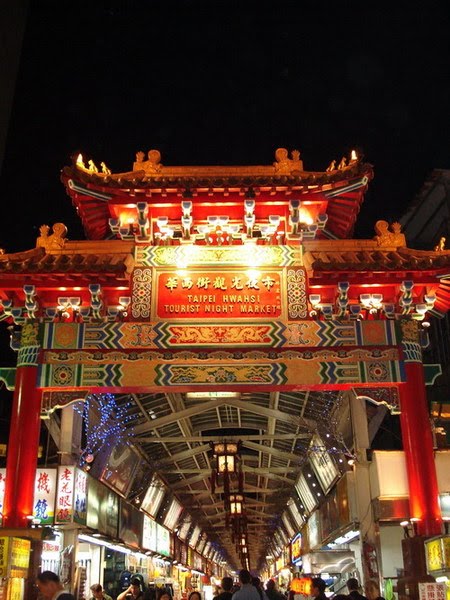
Probably no comestible is as quintessentially Taiwanese as the xiaochi, or “little eats,” found at Taipei City’s night markets. Some of these nocturnal haunts are meandering collections of stalls and food carts on streets lined with clothing and record shops (such as the Times Square-like Ximending marketplace). Others are more formal structures. The oldest of these is the covered food court at Shilin, where diners have sampled the wares of more than 500 peddlers since 1910. Year-round, a crush of students, midnight noshers and hipsters fills the pleasingly run-down enclosure lined with stalls hawking deep-fried milk, oyster omelets and da chang bao xiao chang (literally “big sausage wraps small sausage” — the little sausage is pork, stuffed inside a casing made from compressed glutinous rice).
I brace myself for another culinary rite of passage: trying chou doufu (“stinky tofu”), fermented blocks of spongy bean curd often served deep-fried and topped with pickled vegetables and a gooey, bittersweet sauce. The snack’s stench varies from vendor to vendor, but its bark can mercifully be worse than the first bite. Pleasantly chewy, it has a slightly sour flavor with a pungent, mustardlike kick.
In daylight, Taipei has a run-down quality that no one would blame you for describing as dingy. Summer’s extreme humidity leaves tracks of mold on many facades. The modern, glass-fronted buildings surrounding the massive skyscraper Taipei 101 in the Xinyi District suggest a shift toward cleaner, starker development, but a trip to older parts of the city reveals hidden corners untouched by modernity.
The oldest section, Wanhua, with its winding corridors and quiet decay, offers a glimpse of the city’s bygone days. At its bustling heart is the busy Longshan Temple. I bump past a flurry of tourists, worshipers and monks selling prayer beads outside the gates to reach the controlled chaos within, where hundreds of faithful light incense and present offerings at myriad shrines to Buddha and other deities.
Students in starched uniforms are a common sight here, coming to plead for high marks on exams and good news at the end of the school term. Other visitors leave gifts of remembrance or tokens meant to assist the unlucky in love.
In the temple’s shadow is the claustrophobic artery known as Herb Alley, a hub for Chinese-medicine vendors. Pushing past loosely bundled dried roots and dried shark fins dangling from hooks, I peruse open bags of exotic dried mushrooms, fragrant rose petals and pungent tangles of ginger and ginseng.
A short walk from Herb Alley is the city’s wholesale fabric district. At its nucleus stands a crumbling two-story building crammed with textile merchants advertising silks, satins and variations on the most popular local pattern: a vibrantly colored background splayed with peonies or other bright flowers, often referred to simply as “floral cloth.” After bargaining with a vendor selling the stuff sewn into pillowcases, I snatch it up elsewhere by the yard to use as eye-catching gift wrap.
Interested in more time travel, I take a leisurely day trip to the lush tea-growing region of Maokong, which involves a breathtaking if vertigo-inducing sky-gondola ride. The mountain’s former fame as an oolong-producing region has faded, but the gondola’s slow, 25-minute climb gives you an incredible bird’s-eye view of tiny backyard vegetable gardens and temples snuggled in the dense foliage below.
Once in hilly Maokong, I have some serious hiking to do before reaching the strip of Zhinan, the main road flanked by teahouses. I settle on a teahouse high atop a ledge for the fabled tea ceremony: a way of systematically brewing and re-brewing the leaves to draw out their flavor.
There’s often a little wistful local mysticism offered while the oolong unfurls in its clay pot. “I grew up here, and moved to the city as a young man,” the tea merchant says quietly as he pours bitter green liquid into my cup. “It gets so dark here at night, some people are afraid. But I missed this place, and I came back. I’m not afraid of the mountain. It is my home; I am from here.”
Just like the steaming cup of tea before me, he is very proudly made in Taiwan.
Meister is a New York-based writer, coffee professional and author of the blog the Nervous Cook (www.thenervouscook.com)."
See!? Come to Taiwan and stay with us, What you waiting for??